Five Football Films That Know It’s More Than a Game

The FIFA World Cup, kicks off on Friday. Recce Gossip has already provided you with some great recommendations of football documentaries to watch. Now it’s the turn of fiction.
Documentaries give us the facts, the footage and the dressing-room truth. Fiction can do something quite different. It can bottle the feeling. The pre-match nerves. The irrational hope. The rows about team selection. The family member who suddenly becomes a tactical genius from the sofa. The idea that 90 minutes can ruin your weekend, save your week or convince you that destiny is real.
Football films are tricky. Get the match scenes wrong and we will spot it from the back row. Get the emotion right, though, and suddenly it does not matter whether the final shot bends into the top corner or disappears over the stand. The best football films are not really about football. They are about why football matters.
So, ahead of the World Cup, here are five very different fiction films that give you real insight into the beautiful game.
Offside
2006, Director: Jafar Panahi
 We start outside the stadium.
This film is not built around a last-minute winner, a heroic captain or a dressing-room speech that makes everyone want to run through a wall. It's about a group of women in Iran trying to get into a World Cup qualifier, despite being banned from attending.
Offside understands that football isn't just about what happens on the pitch. It is about who gets to be there. Who gets to sing. Who gets to suffer. Who gets to celebrate with strangers. Who gets to say, “I was there.”
For most fans, going to a match is beautifully ordinary. You queue, you complain about the price of food, you question the manager’s sanity, then you spend 90 minutes behaving in a way that would worry your family if they saw it anywhere else.
Offside flips that on its head. It shows that for some people, simply getting through the turnstile is an act of defiance.
Funny, tense, political and full of life, it is a reminder that football belongs to everyone, even when the world tries to say otherwise.
The Damned United
2009, Director: Tom Hooper
 From being locked out of football to being completely consumed by it.
The Damned United gives us Michael Sheen as Brian Clough, which is one of those actor-role combinations that feels almost unfair on every other actor. Sheen beautifully captures Clough as charming, brilliant, wounded, arrogant and just insecure enough to make the whole thing dangerous.
The film focuses on Clough’s disastrous 44 days at Leeds United, but really it is about ego. That very football-specific type of ego where a man believes he can walk into a club, change the culture, beat his enemies, prove everyone wrong and still have time to deliver a few perfect one-liners on the way out.
This is not football as fantasy. This is football as obsession.
There are no endless slow-motion goals here. The real action is in dressing rooms, corridors, offices, press conferences and old grudges that never stay buried. It is about the bit of football we all pretend is secondary, even though we secretly know it drives everything: personality.
Managers are not supposed to be the main characters, but football keeps making them that way. The Damned United knows this. It understands the cult of the boss, the madness of rivalry and the fine line between genius and self-destruction.
Sharp, funny and painful, it is still one of the best British films ever made about the game.
Looking for Eric
2009, Director: Ken Loach
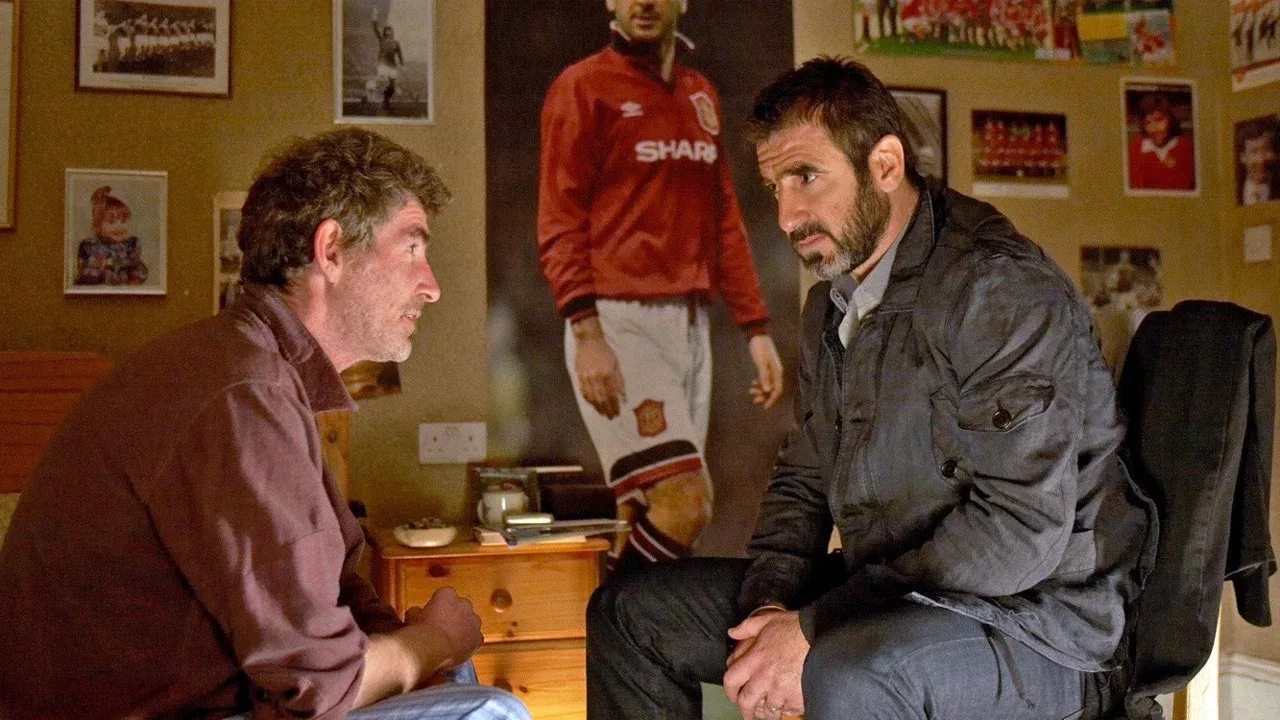 Every football fan has, at some point, looked to a former hero for answers. Usually it is in a pub, on a podcast, or while watching a grainy YouTube clip of a goal from 1996. In Looking for Eric, it is a bit more direct. A struggling Manchester postman starts receiving life advice from an imaginary Eric Cantona.
Ridiculous? Completely. Does it work? Somehow, beautifully.
Ken Loach’s film is not really about Manchester United. It is not really about Cantona either, although the great man appears with exactly the right level of mystery, mischief and popped-collar philosophy. It is about what football gives people when life gets heavy.
A club can be a memory bank. A comfort blanket. A weekly heartbreak machine. A reason to call your mates. A way of feeling like you still belong to something, even when everything else is wobbling.
The film understands fandom as therapy, madness, identity and escape. It knows football can make absolutely no sense and still be the thing that keeps you going.
Sometimes the result is not the point. Sometimes just having the team, the memories and the myth is enough.
Shaolin Soccer
2001, Director: Stephen Chow
 And then, just when things are getting thoughtful, in comes Shaolin Soccer with a flying kung fu volley to the face.
Stephen Chow’s football action-comedy is completely, wonderfully, gloriously unhinged. It takes the beautiful game, feeds it energy drinks, gives it superpowers and launches it through a wall.
Is this a realistic depiction of football? No. Is that a problem? Also no. Because Shaolin Soccer understands something most “serious” football films miss: football is already ridiculous. We just pretend it is normal because we love it.
Fans talk about wondergoals as if gravity briefly took a break. We describe players as magicians. We watch replays of volleys and screamers like sacred texts. We spend our lives hoping to see the impossible happen in real time.
The tackles are absurd. The shots are absurd. The whole thing is absurd. But buried inside the madness is real football joy. It captures the playground version of the game, where every kick is heroic, every save is impossible and every player secretly believes they are one touch away from greatness.
Bend It Like Beckham
2002, Director: Gurinder Chadha
 We end with a film that still feels like a warm hug, a proper laugh and a two-footed tackle on outdated expectations. Bend It Like Beckham follows Jess, a British-Indian teenager who dreams of playing football while her family has very different ideas about what her future should look like.
It is funny, charming and hugely rewatchable, but its real power is that it understands football as freedom.
For Jess, the game is not just something she enjoys. It is where she feels most like herself. It is confidence. It is ambition. It is escape. It is the place where she can imagine a life that belongs to her.
The film arrived long before women’s football had the mainstream momentum it has now, but it understood where things were heading. It knew that girls and women were not waiting to be invited into football. They were already there, already playing, already dreaming, already bending the ball around every barrier put in front of them.
It also does something deceptively difficult: it makes its point without losing its sparkle. It is full of family pressure, cultural expectation and generational tension, but it never forgets to be funny. It has heart, pace, great characters and one of the best titles in sports movie history.
That is why it remains such a classic. Not because it treats football like life and death, but because it knows football can help you find a life that feels like yours.
That's the real beauty of these five films. They are not all about winning. They aren't all about trophies. Some barely show any football. But together they show why the game gets under our skin.
It is access. Ego. Escape. Joy. Freedom. The beautiful game, doing what it always does: making no sense at all, while somehow explaining everything.
Jim Irving
Author